

Journal Update
GINA Track-1 Improves Asthma Control and Reduces Environmental Impact Compared with Track-2
Background
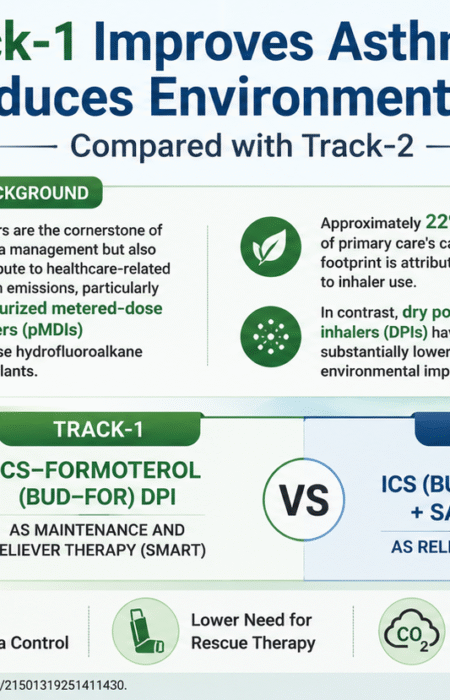
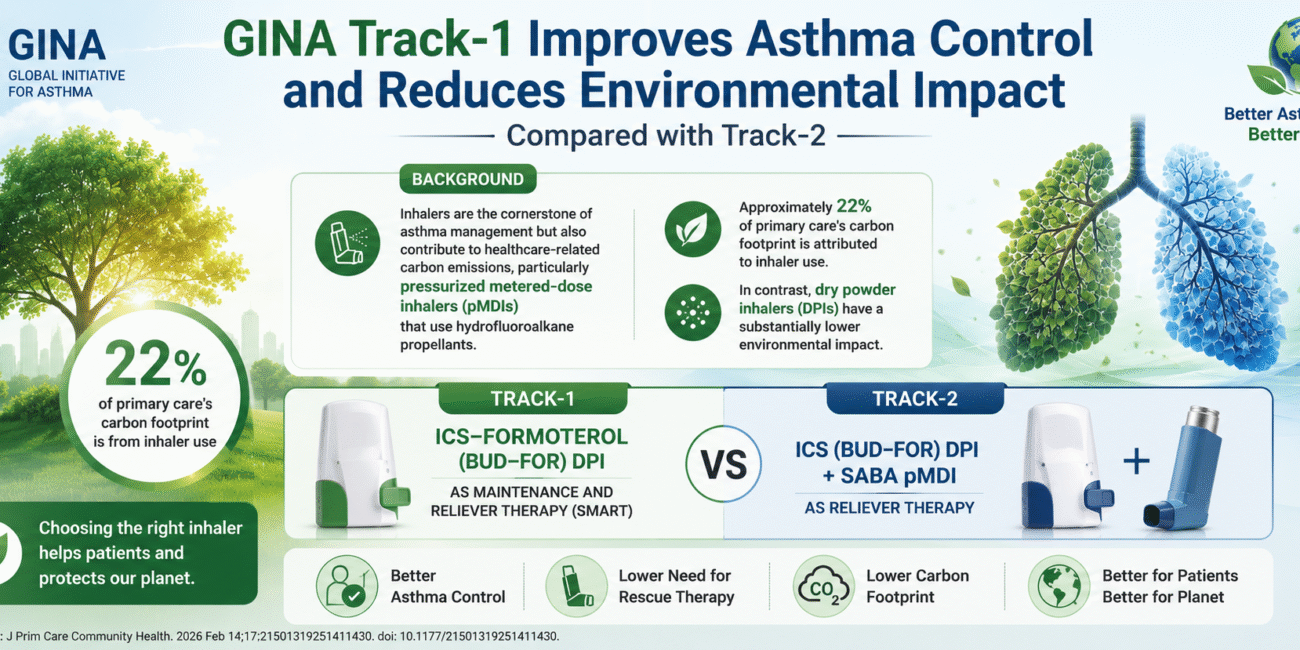
Inhalers are the cornerstone of asthma management but also contribute to healthcare-related carbon emissions, particularly pressurized metered-dose inhalers (pMDIs) that use hydrofluoroalkane propellants. Approximately 22% of primary care’s carbon footprint is attributed to inhaler use. In contrast, dry powder inhalers (DPIs) have a substantially lower environmental impact.
The Global Initiative for Asthma (GINA) recommends:
- Track-1: Low-dose ICS–Formoterol as both maintenance and reliever therapy (SMART).
- Track-2: Maintenance ICS-containing therapy with SABA as the reliever.
This study evaluated the long-term clinical outcomes and environmental impact of these two treatment strategies in Singapore’s primary care setting.

Objective
To compare:
- Asthma control
- Rescue medication use
- Carbon footprint
between adult asthma patients receiving:
- Track-1: Budesonide–Formoterol (BUD/FOR) DPI as maintenance and reliever therapy (SMART)
- Track-2: Budesonide–Formoterol DPI with SABA pMDI as reliever
Study Design
- Retrospective longitudinal study
- Electronic Medical Records (EMR) analysis
- Eight public primary care clinics in Singapore
- Study period: 2018–2023
Study Population
- Adults aged ≥21 years
- Clinical diagnosis of asthma
- At least one Asthma Control Test (ACT) score recorded annually
Methods
Data collected included:
- Inhaler dispensing records
- Asthma Control Test (ACT) scores
- Rescue therapy utilization
- Carbon footprint (based on inhaler canisters dispensed)
Generalized Estimating Equations (GEE) were used to evaluate associations between treatment strategy, asthma control, rescue therapy use, and carbon footprint.
Study Endpoints
- Number of inhalers dispensed
- Asthma control (ACT score)
- Carbon footprint (kgCO₂e)
- Rescue therapy requirement
Key Results
Patient Population
- 5,634 adult asthma patients treated with BUD/FOR DPI
Treatment Trends
- Track-1 use increased markedly:
- 466 → 2,317 patients
- Track-2 use increased modestly:
- 628 → 758 patients
Asthma Control
Patients achieving good asthma control (ACT ≥20) in 2023:
- Track-1: 78.5%
- Track-2: 68.7%
Patients receiving Track-1 were:
- 1.5 times more likely to achieve good asthma control (p <0.001)
Rescue Therapy
Compared with Track-2, Track-1 patients had:
- ~30% lower odds of requiring rescue therapy (p <0.001)
Average SABA-pMDI use declined:
- 2.8 → 2.1 canisters/patient/year
Carbon Footprint
Average carbon footprint per patient:
- Track-1: 3.3 kgCO₂e
- Track-2: 62.4 kgCO₂e
Track-1 reduced carbon emissions by approximately 60 kgCO₂e per patient (p <0.001).
Inhaler Utilization
Average annual BUD/FOR inhalers dispensed:
- Track-1: 4.1 inhalers/patient
- Track-2: 5.3 inhalers/patient
Difference:
- 1.2 fewer inhalers per patient per year with Track-1.
Clinical Take-Home Message
✅ GINA Track-1 (ICS–Formoterol SMART) provides:
- Better asthma control
- Reduced need for rescue medication
- Lower inhaler utilization
- Dramatically lower carbon footprint
Adopting Track-1 can improve both patient outcomes and environmental sustainability, supporting a more effective and eco-friendly approach to asthma management.
Reference
J Prim Care Community Health. 2026;17:21501319251411430.
Published online: February 14, 2026.
doi: 10.1177/21501319251411430.
Pulmocure 200/400 respiratory capsule for inhalation

Other Articles
Ventila DPI™ – Advanced Two-Pin Dry Powder Inhaler